
Via Luce’s risk process separates the household’s capacity for loss from the rules governing portfolio exposure and investment selection. Market information is reviewed within the applicable framework. A review may lead to a change, or it may support maintaining the existing position. Neither result removes investment risk.
The question during a difficult market is often, “Are we doing anything?” A useful answer should explain what is being evaluated, which decisions the information informs, and what would make the current approach inappropriate for your household. The number of trades alone cannot answer those questions.
Recent conditions make that distinction relevant. In its September 28, 2026 commentary, Cboe described individual-stock implied volatility increasing while S&P 500 index volatility remained subdued. A broad benchmark can therefore give an incomplete impression of the uncertainty affecting particular investments. That observation is context for a review, not an instruction to sell.
Begin with the risk the household can carry
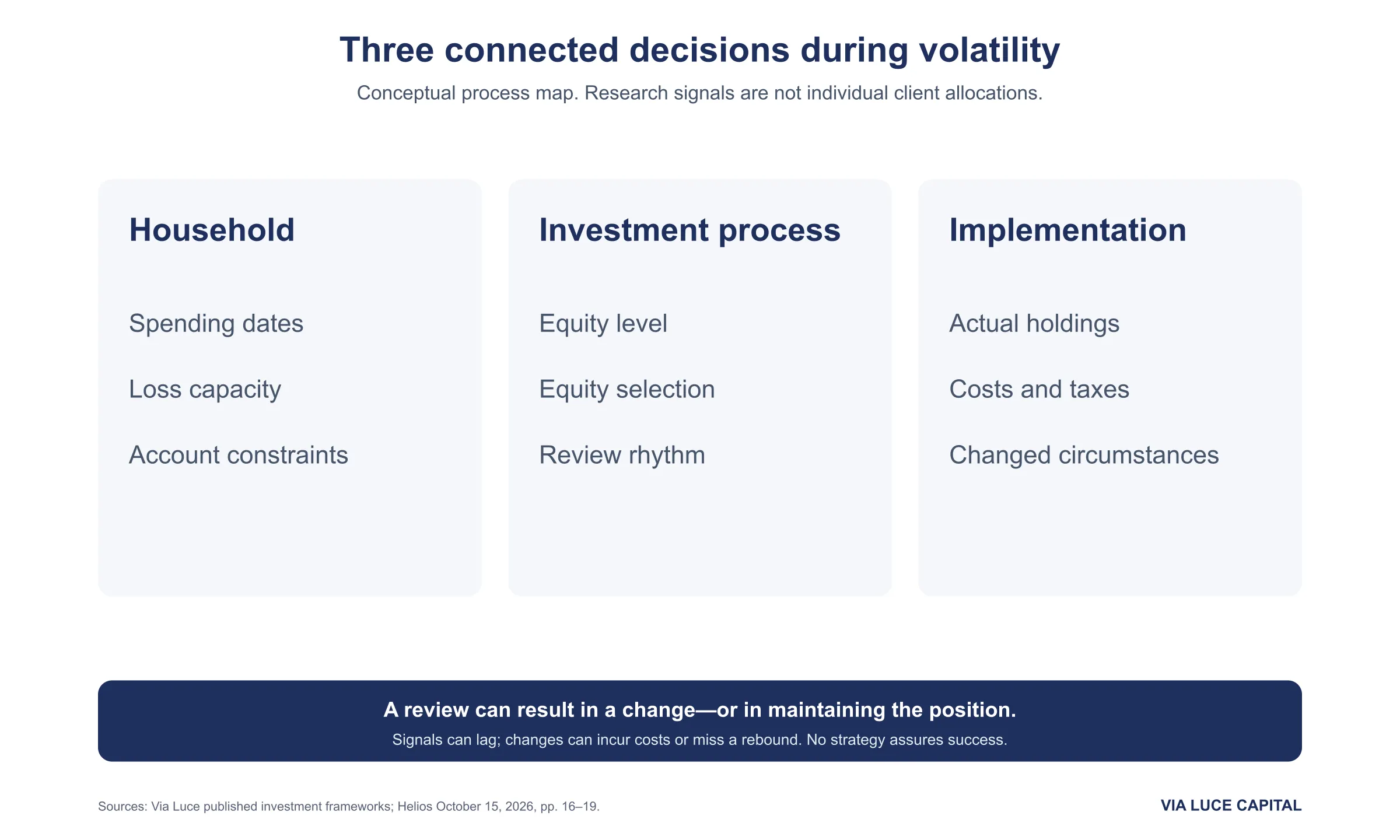
The starting point is the plan: when money is needed, how much spending depends on investment withdrawals, what other resources are available, and what losses the household could withstand. A long investment horizon does not make next month’s bill a long-term obligation.
Willingness to accept market movement and financial capacity to absorb a loss are also different. Someone may feel comfortable with uncertainty while depending heavily on withdrawals. Another household may have substantial outside income but find large account fluctuations difficult to tolerate. Both facts deserve attention.
The initial equity target and the framework used around it should reflect that context. A framework name is not a substitute for the conversation. Nor does a questionnaire response by itself establish the appropriate allocation or confirm that an existing approach remains suitable after circumstances change.
Separate how much equity from which equity
Two decisions can be confused when discussing a portfolio. The first concerns the amount of equity exposure. The second concerns how the equity portion is allocated among market styles, factors, sectors, and geographic exposures.
Changing the mix within equities does not necessarily reduce total equity exposure. A shift between equity styles may leave the household exposed to a broad stock-market decline. Conversely, reducing equity exposure changes the overall mix but does not establish that the remaining assets have no risk.
Helios research supports these distinct questions through level elements and style elements. Those research outputs are inputs to an investment process. A percentage shown for a research element should not be read as the percentage held in your account. Your mandate, implementation, and actual holdings require their own review.
What Alpha and Guardian review
The published Via Luce investment frameworks describe Alpha as a macro-led approach. Selective Macro informs the equity level, while Tactical Equity addresses where the equity portion participates. Its typical rhythm is monthly Macro and Tactical reviews. The framework can involve active changes and meaningful differences from a market benchmark.
Guardian uses market trend and expected-volatility inputs to inform changes in equity exposure, alongside Focused Equity selection. Its published typical rhythm is twice-monthly risk-level reviews and monthly Focused Equity reviews. Volatility, credit conditions, and investor sentiment contribute to the assessment of market stress.
These are descriptions of the process, not promises of a particular trade or result. A scheduled review is not continuous intraday trading. More frequent review does not establish that a decline will be avoided, and less frequent trading does not establish that a portfolio is less risky.
Why a review can result in no change
The October 15, 2026 Helios report provides a useful dated example. It discussed elevated market risks while leaving its reviewed level-element positions unchanged. It also identified Economic and Selective Macro as elements that do not recalculate mid-month. Those observations concern the research process, not a claim about every client account.
Market inputs can disagree. Price trend may remain positive while other measures indicate uncertainty. A framework can recognize those concerns without its decision rules calling for an additional reduction in exposure at that review. “No change” and “no risk” mean different things.
The relevant follow-up is to ask why the decision follows the process and whether that process still fits the household. Replacing a rule whenever the latest headline feels alarming would create a different decision method. That does not mean rules are beyond scrutiny; their assumptions, limitations, and implementation should remain open to review.
Understand the cost of responsiveness
Risk signals use imperfect information. A process may respond after prices have already fallen. It may reduce exposure and then face a rapid rebound. It may add exposure before another decline. Changes that reverse in a choppy market can generate costs without producing the intended benefit.
Trading may also create taxable gains, transaction expenses, or other implementation effects. The account type and the timing of withdrawals matter. A choice that fits a tax-deferred account may create different trade-offs in a taxable account with substantial unrealized gains.
Periods of benchmark lag also require honest evaluation. A strategy that holds different exposures should be expected to behave differently. That difference does not prove the strategy has failed, but neither does adherence to rules excuse ignoring results, costs, or a mismatch with the client’s objectives. There is no assurance of later catch-up.
Keep the household review beside the market review
Tell Brent when an expense becomes unavoidable, a retirement date moves, employment changes, or family support becomes necessary. These developments can affect the plan even if the market research has not changed. Waiting for a market signal is not an appropriate way to communicate a new cash need.
Ask to see the relationship among the chosen target, the framework, current holdings, and anticipated withdrawals. Clarify what is a research observation and what has actually been implemented. Also include outside accounts; the investment process cannot be evaluated fully by looking at one account in isolation.
For a review conversation, four practical questions are useful: What changed in the evidence? Did the applicable rules call for a change? What costs or constraints matter to implementation? Has anything changed in our household that requires a separate decision? These questions keep the discussion specific without demanding a forecast.
Make the review record useful
A review record should make that distinction visible. It can state the review date, the information considered, the applicable decision, and any implementation limitation. A research update and an account statement serve different purposes: one explains the input; the other shows the holdings. If a client request or account restriction changes implementation, that difference should be understood rather than hidden behind a model label.
This also gives the next conversation a reference point. A changed conclusion can be compared with what was known at the prior review. The purpose is an intelligible decision record, not a story that makes every past choice appear inevitable.
Sources
- Alpha combines Selective Macro with Tactical Equity; its typical reviews are monthly. Guardian combines trend and expected-volatility inputs with Focused Equity; risk level is reviewed twice monthly and Focused Equity monthly. — Via Luce Capital, published investment framework detail views; reviewed October 17, 2026.
- The September report distinguishes level elements from equity styles and describes their separate review decisions. — Helios Quantitative Research, September 30, 2026 Due Diligence Report, pp. 18–23 and 29–32; advisor research material supplied for this review; reviewed October 17, 2026.
- The October 15 report describes elevated risks while retaining its level-element positions; two elements are not recalculated mid-month. These are research-element observations, not client allocations. — Helios Quantitative Research, October 15, 2026 Mid-Month Due Diligence Report, pp. 16–19; advisor research material supplied for this review; reviewed October 17, 2026.
- Time horizon and risk tolerance inform asset allocation; diversification and allocation do not remove investment risk. — U.S. Securities and Exchange Commission, Asset Allocation and Diversification; reviewed October 17, 2026.
- Index-level and individual-stock implied volatility can diverge; September observations are dated rather than statements about every later trading day. — Cboe, Equities Unfazed by Spike in Rates Volatility, September 28, 2026; reviewed October 17, 2026.
- The three-stage diagram is an original conceptual explanation of household context, portfolio decisions, and implementation review; it is not a model formula. — Via Luce Capital, author-created educational diagram; reviewed October 17, 2026.