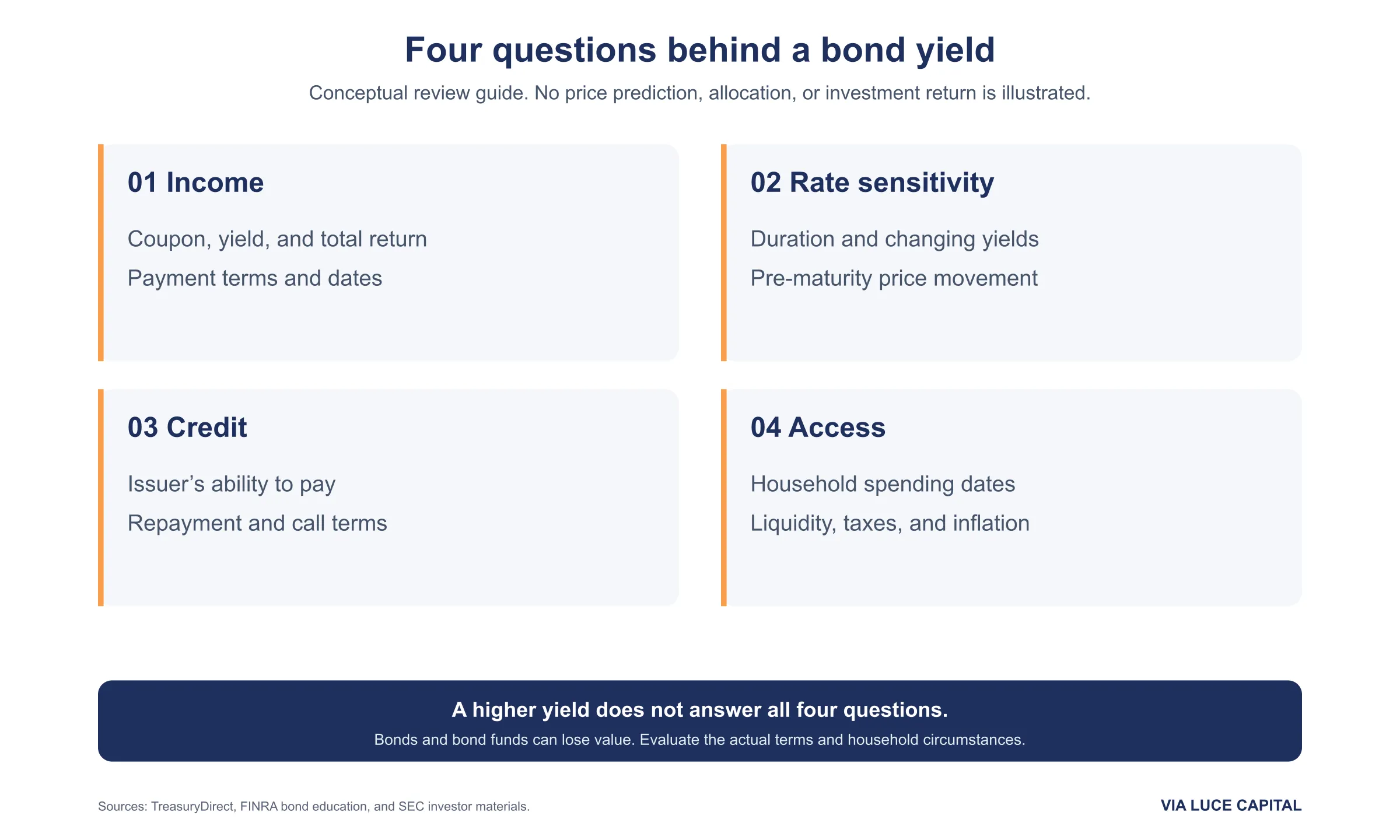
Higher bond yields can make income choices worth revisiting. They do not establish that the investment is less risky. Evaluate the income terms, sensitivity to changing rates, issuer’s ability to pay, access to the money, and tax treatment together. A yield is one input to a decision, not a description of the entire holding.
The current environment illustrates why that matters. The U.S. Treasury’s October 16, 2026 table reported a ten-year constant-maturity par yield of 5.09%. This is a dated market reference derived from indicative prices. It is not a rate available on every account, a bond coupon, or a promised return to an investor.
Higher available yields can coexist with uncomfortable price changes. In its October 5 commentary, Cboe distinguished interest-rate uncertainty in investment-grade bonds from investors demanding more compensation for lower-quality credit risk. Those are different reasons for a bond position to experience stress, and they require different questions.
Decide which job the holding is meant to do
Begin with the household’s purpose. Is the money intended to meet a known expense, contribute recurring income, diversify equity exposure, or support longer-term investment goals? A holding that fits one job may be a poor match for another, even when its yield looks attractive.
For a known payment date, access and the timing of principal matter. For ongoing income, payment terms and the ability to continue paying matter. For a diversifying role, consider how the exposure may behave alongside the other investments. A portfolio can contain several bond positions serving different purposes.
Write the purpose before comparing yields. Otherwise, the highest number can quietly change the assignment: funds intended for a near-term obligation may end up in a longer, less liquid, or lower-quality exposure. The additional yield then comes with a risk the household did not intend to take.
Separate coupon, yield, and total return
A fixed-rate bond’s coupon determines its interest payments relative to face value. Its market price can move after issuance. The same stated coupon can therefore represent a different yield depending on what an investor pays and which yield measure is used.
Current yield relates annual coupon income to market price. Yield to maturity incorporates the price, scheduled payments, and repayment at maturity under stated assumptions. Callable bonds require attention to possible earlier repayment as well. Ask what the quoted measure assumes and which costs it excludes.
Total return includes income and changes in value over the holding period. Receiving an interest payment does not prevent a larger price decline. Likewise, a quoted distribution rate on a fund should not be assumed to equal the investor’s total return or a sustainable spending rate.
Understand the rate sensitivity you are accepting
When required market yields rise, existing fixed-rate bond prices generally fall. Duration is a measure of sensitivity to that change. It reflects the timing and characteristics of cash flows and is not simply another name for the maturity date.
A longer-duration holding generally has greater price sensitivity to a given yield change than a shorter-duration holding, other factors being equal. Actual movements can differ because of changing credit spreads, embedded options, and other conditions. Duration is a useful estimate, not a full description of possible losses.
Short duration also involves trade-offs. Money returned sooner must be reinvested or spent, and future available rates may be lower. Extending maturity can establish different payment terms but exposes the investor to a longer period of price and inflation uncertainty. Neither choice is automatically appropriate for every income need.
Ask why the yield is higher
A higher yield may compensate for a borrower’s weaker finances, a longer commitment, limited trading liquidity, or a provision allowing the issuer to repay early. Compare instruments with similar terms before deciding that one is simply more generous than another.
Credit risk is the possibility that the issuer will not meet its obligations. Lower-rated bonds generally offer higher yields with greater risk of default. They can also become less liquid or decline when investors demand a wider credit spread, even if the issuer has not missed a payment.
High-quality bonds still have risks. Government payment backing does not guarantee the price available if a security is sold before maturity. Corporate credit quality can change. Spreading holdings across issuers can potentially reduce dependence on one borrower, but diversification cannot prevent market losses.
Match maturity and liquidity to the calendar
An individual bond held to maturity has specified payment terms, subject to the issuer meeting its obligations. If the owner needs cash earlier, the sale price can be above or below the purchase price. A callable bond adds the possibility that repayment arrives sooner than planned.
A conventional bond fund holds a changing portfolio and generally does not promise each shareholder a particular principal payment on a chosen date. Its distributions and share value fluctuate with the holdings and its approach. That does not make it unsuitable; it means its role differs from a specific maturity payment.
A maturity ladder spreads repayment dates and creates scheduled review points. It still involves issuer risk, reinvestment decisions, and possible sale losses if cash is needed early. Confirm which payments are already assigned to future bills before treating a maturity as money available for another purpose.
Compare spendable income and the remaining risks
Tax treatment can change the comparison. Treasury interest is generally subject to federal income tax but exempt from state and local income taxes. Municipal and corporate interest have their own rules, and an account’s tax treatment also matters. Use the actual security and household circumstances rather than a category label alone.
Inflation is a separate issue. A fixed nominal payment can buy less over time. More current income also does not necessarily compensate for all the risks attached to the investment. Consider how the payment fits the household’s spending, rather than assuming the entire yield should be spent.
Finally, review the whole mix. Equities, bonds, cash, and any contractual income can respond differently to the same environment. The question is whether the combined exposures fit the household’s objectives and constraints. No forecast of the next interest-rate move is required to identify a mismatch between a holding and its assigned job.
Bring comparable terms to the review
Use the same review date and quote basis when comparing choices. Record the price, accrued interest where applicable, estimated transaction cost, quoted yield measure, earliest call date, and maturity. A figure taken from a statement several weeks earlier may not describe the terms available for a new purchase today.
For an existing position, ask whether its purpose has changed before reacting to a lower statement value. Money assigned to a distant payment and money needed next month create different decisions. Conversely, a familiar holding should not escape review when its credit quality, liquidity, or household role has changed.
Sources
- The official October 16, 2026 daily Treasury table lists a ten-year constant-maturity par yield of 5.09%. These are interpolated par yields derived from indicative bid-side prices, not transaction quotes. — U.S. Department of the Treasury, Daily Treasury Par Yield Curve Rates, October 16, 2026; reviewed October 17, 2026.
- The October 5 commentary distinguishes rate uncertainty affecting investment-grade bond volatility from increased compensation demanded for lower-quality credit risk. — Cboe, Equity Markets Remain Resilient Amidst Continued Yield Surge, October 5, 2026; reviewed October 17, 2026.
- Duration estimates sensitivity to changing yields; low duration does not remove other bond risks. — FINRA, Duration—What an Interest Rate Hike Could Do to Your Bond Portfolio; reviewed October 17, 2026.
- Bond review includes issuer credit, terms, taxes, liquidity, and the reasons yields differ. — FINRA, Bond Investing and Due Diligence; reviewed October 17, 2026.
- Bond prices, coupons, maturity, and issuer payment obligations are distinct; selling before maturity can produce a different result from holding to maturity. — U.S. Securities and Exchange Commission, Bonds; reviewed October 17, 2026.
- Treasury notes have fixed interest payments and stated maturities; federal interest is subject to federal tax and exempt from state and local tax. — TreasuryDirect, Treasury Notes; reviewed October 17, 2026.
- Lower-rated corporate debt offers higher yields with greater default and other risks. — U.S. Securities and Exchange Commission, High-yield Corporate Bonds; reviewed October 17, 2026.
- Current yield, yield to maturity, yield to call, and yields reflecting broker compensation measure different aspects of a bond purchase. — FINRA-hosted NASD investor education, Corporate Bond Education, March 2005; used for definitions, not current market conditions; reviewed October 17, 2026.
- The income, rate, credit, and access diagram is original conceptual educational material, not a pricing model or projection. — Via Luce Capital, author-created diagram; reviewed October 17, 2026.