A portfolio isn’t what you own. It’s the decisions that decide what you own — over and over.
Ask most people to describe their portfolio and they’ll tell you what’s in it: this much in stocks, some bonds, a handful of funds. That’s a fair answer, but it describes the output, not the thing itself. The holdings are a snapshot. The real portfolio is the set of decisions that produced them — and, more to the point, the decisions that will reshape them next quarter and next year. Get the decisions right and the holdings follow. Assemble holdings without a method for changing them, and you’re one surprise away from improvising with real money.
Rules-based construction starts from that reframing: build the decisions first.
A portfolio is decisions, not holdings
A pie chart tells you where a portfolio is today. It says nothing about how it got there or what happens when markets move — and “what happens when markets move” is where almost all the outcome lives. Two investors can hold an identical mix today and end up worlds apart, simply because one had a defined method for responding to change and the other made it up as conditions shifted. Construction, done well, is mostly about that method — the rules that govern how the portfolio adapts — not the opening snapshot.
Decide before you have to
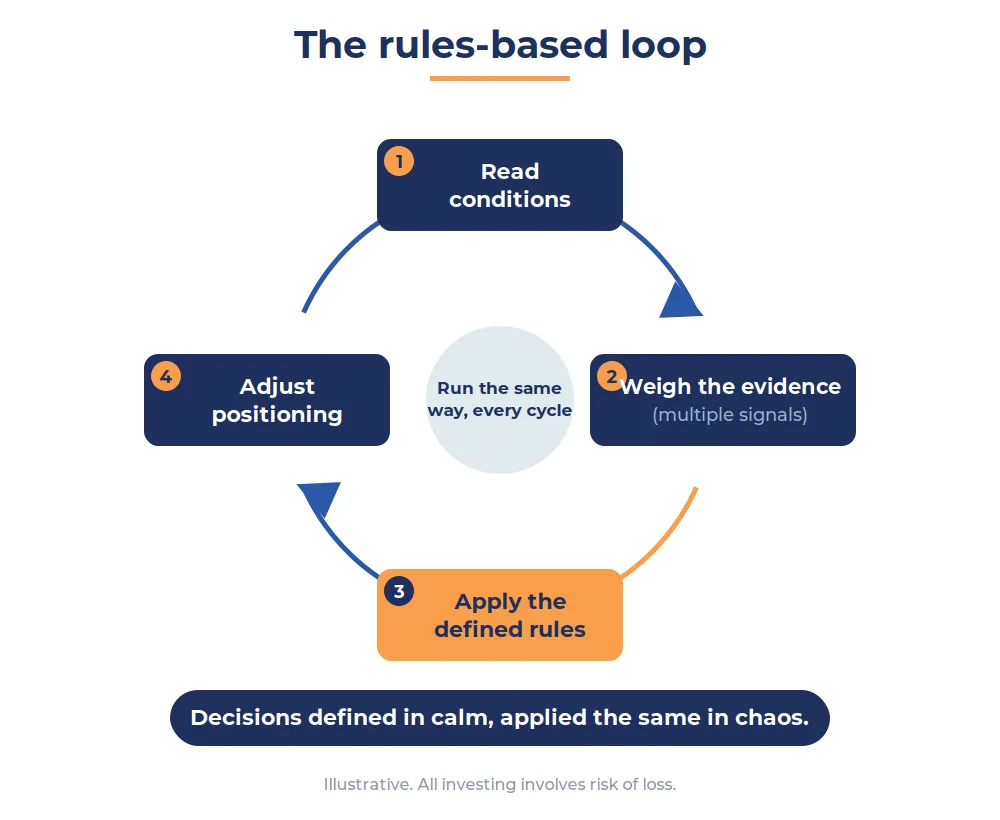
The central move in rules-based construction is committing to decisions in advance. Before a position goes in, the rules already define what would lead the process to trim it, add to it, or step away. Before a drawdown arrives, the response is already specified.
This matters because the worst possible moment to decide how much risk you can stomach is in the middle of losing money. Emotion peaks exactly when judgment is most expensive. Pre-committing to a rule doesn’t make you smarter; it makes you consistent — it lets the calm version of you set the terms the anxious version has to follow.
Diversify the inputs, not just the assets
Most people hear “diversification” and think about owning different things — stocks and bonds, domestic and foreign. That’s part of it, but it’s the shallow part. The deeper diversification is in the evidence the decisions rest on.
A portfolio steered by a single indicator or a single thesis is fragile no matter how many tickers it holds, because every decision traces back to one source of truth. Rules-based construction spreads the decision-making across multiple, largely uncorrelated signals, so no single read carries the portfolio. You can own a hundred securities and still have an undiversified decision process; the goal is to diversify both.
Rebalancing by rule, not by mood
Left alone, a portfolio drifts — winners grow until they dominate, and risk quietly climbs past where you intended. Something has to bring it back. The question is what.
Discretionary management brings it back by judgment, which makes it vulnerable to the same emotions as everything else: reluctance to trim a winner, eagerness to chase a theme. Rules-based construction brings it back by rule — adjustments triggered by defined conditions rather than by how the market felt that week. The portfolio is designed with a goal to be maintained the same way in good weather and bad.
Risk inside defined lines
A rules-based portfolio is built with a goal to operate within a stated risk range rather than wandering. That range is set by your plan — your objectives, your time horizon, what you actually need the money to do — and the same construction discipline applies whether the target is conservative or aggressive. The level of risk changes with the mandate; the rigor of how it’s managed does not.
Why consistency beats brilliance
Here’s the quiet truth that makes all of this worth the effort: a rules-based portfolio isn’t trying to be brilliant in any single year. It’s trying to be consistent across all of them.
Brilliance is hard to repeat and impossible to schedule. Consistency compounds. A process that behaves predictably across cycles — that doesn’t panic-sell at the bottom or pile in at the top — clears a bar that dazzling-but-erratic management rarely does, because the erratic version tends to give back in the bad years what it won in the good ones. None of this guarantees a result; all investing carries risk, including the possible loss of principal. But construction made for consistency is built with a goal to keep you in your plan when staying in it is hardest.
Where this leaves you
A portfolio constructed this way becomes something you don’t have to watch with your stomach in knots. It’s governed by rules set in calm, fed by diversified evidence, maintained by method, and bounded by the risk your plan calls for. That’s the point of building it well — not to predict the next move, but to already know how you’ll respond to it.
A portfolio you have to defend in a crisis was built wrong. One built on rules already knows what to do.
The holdings are the output. The rules are the work.