
How success turns into concentration
It rarely happens on purpose. You take equity in a company you believe in, or you build the company yourself. It does well — sometimes spectacularly well. And one day the balance sheet shows that a single holding has quietly grown into most of your net worth.
This is a familiar story in Orange County. The same defense and AI companies drawing national attention have created a great deal of local paper wealth, much of it held by founders and early employees in private shares they cannot freely sell. Business owners know the dynamic in a different form: for most, the company represents the overwhelming majority of what they are worth, and it does not trade on any exchange.
The asset that made you wealthy is now the asset that can unmake the plan. That is not a reason to panic. It is a reason to be deliberate.
Two problems, not one
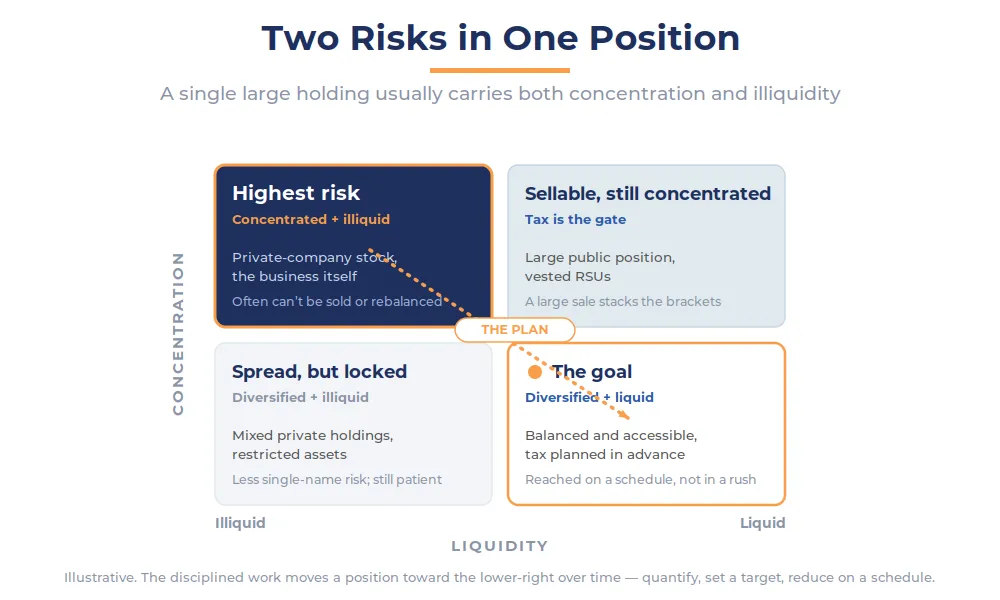
Concentration and illiquidity are separate issues, and a large single position usually carries both.
Concentration is the single-point-of-failure problem. When one holding dominates the balance sheet, your net worth — and sometimes your income and identity — rise and fall together. Diversification exists precisely because no one can reliably predict which individual company thrives and which stumbles, and the larger the position, the more a single bad outcome costs.
Illiquidity is the cannot-act-on-it problem. Private-company shares are commonly locked by rights of first refusal and transfer restrictions, so you may not be able to sell or rebalance even when you want to. Concentrated public stock can be sold, but a large sale triggers a tax bill that is easy to underestimate.
The tax bill hides in the timing
For a California resident, this is where good intentions meet a hard number. California taxes capital gains as ordinary income — with no preferential long-term rate — so a large gain can land in the state’s top bracket on top of federal tax. Stack the federal long-term rate and the net investment income tax on top, and a top-bracket seller can face a combined rate in the high-30s on a long-term gain. (Illustrative; your actual rate depends on your full return — model it with your CPA.)
The practical point is not “never sell.” It is that when and how much you sell in a given year drives the outcome. Recognizing a large gain all at once can push everything into the top brackets; spreading sales across tax years can keep more of it out of them.
Founders have an additional question worth raising early: whether their shares qualify for the qualified small business stock rules under Section 1202, which were expanded in 2025 and can exclude a meaningful share of the gain for stock that meets the requirements. That is a CPA conversation, not a do-it-yourself one — and it is best understood years before a sale, not weeks after.
A plan beats a reflex
Faced with a concentrated position, most people lean toward one of two reflexes. They freeze — holding everything out of loyalty, optimism, or a wish to avoid the tax. Or they dump — selling all at once the moment they can, just to be done with it. Both are bets disguised as decisions.
The disciplined alternative is unglamorous and effective. Quantify exactly how concentrated you are. Decide what a reasonable target looks like for your situation. Then reduce toward it on a deliberate schedule as liquidity allows, with the tax modeled in advance and the timing coordinated with your CPA and attorney. Where you already plan to give, gifting appreciated shares — often through a donor-advised fund — can advance the charitable goal and the diversification goal at the same time, though the new 0.5%-of-AGI floor on itemized charitable deductions makes the timing worth planning with your advisor.
None of this requires predicting the stock. That is the point.
The goal isn’t to be right about one company. It’s to make sure your family’s plan doesn’t depend on it.
A concentrated position is a good problem to have. It is still a problem — and like most problems on a balance sheet, it responds far better to a process started early than to a decision made under pressure. The work of quantifying the risk, modeling the tax, and building a measured path to diversification is the same whether your wealth sits in a private company, a founder’s stake, or the business you run. It just has to actually get done.
Sources
- California top marginal rate of 13.3%; capital gains taxed as ordinary income — California Franchise Tax Board