
Two investors own the identical portfolio — same funds, same percentages, same everything. A decade later, one has kept noticeably more of the return than the other. Neither made a better pick. The difference was location: which account each holding sat in.
Most of the attention in investing goes to allocation — what you own and in what proportion. That matters. But a second decision quietly shapes how much of your return you actually keep, and it gets a fraction of the airtime: where you hold each piece. Asset location is the discipline of matching investments to the account types that tax them most favorably. Done well, it can potentially improve your after-tax return without changing your risk, your holdings, or your plan in the slightest.
Allocation is what you own. Location is where you keep it.
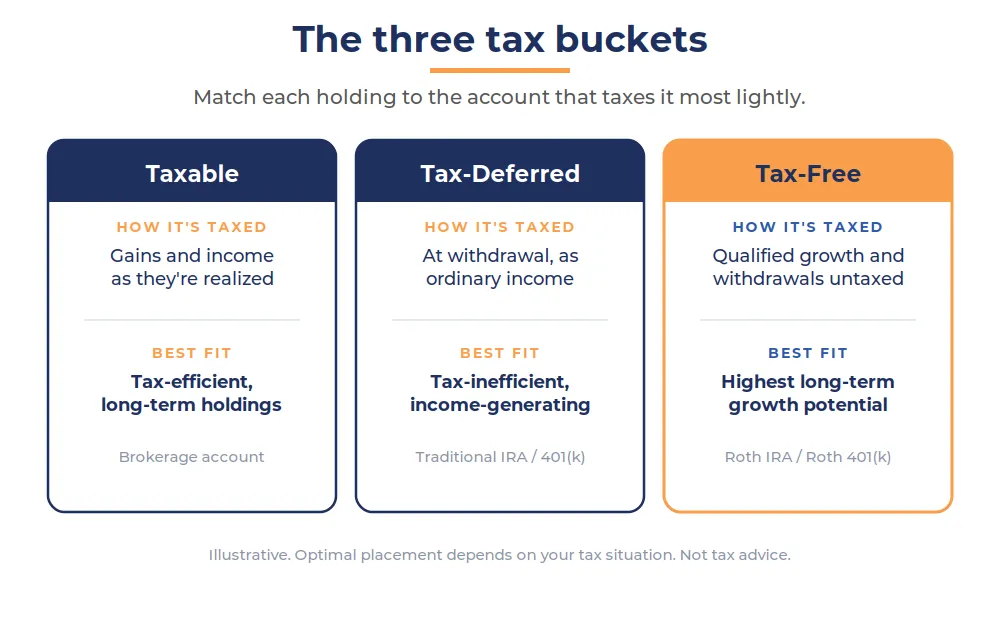
Picture three buckets, each taxed differently. A taxable brokerage account, where you owe tax on income and on gains as they’re realized. A tax-deferred account — a traditional IRA or 401(k) — where money grows untaxed until you withdraw it, then is taxed as ordinary income. And a tax-free account — a Roth — where qualified growth and withdrawals come out untaxed entirely.
Same dollar, three very different outcomes depending on which bucket it grows in. Asset location is simply deciding, deliberately, which holdings belong in which bucket — instead of letting it happen by accident.
Why the placement matters
Different investments are taxed in different ways. Some throw off a lot of taxable income year to year, or are traded frequently, which creates ongoing tax drag. Others are naturally tax-efficient — they grow quietly and are mostly taxed only when you eventually sell, often at lower long-term rates.
The logic of location follows from that. Tax-inefficient holdings — the ones that would generate the biggest annual bill — generally do their best work inside tax-advantaged accounts, where that drag is sheltered. Tax-efficient holdings can sit comfortably in a taxable account, because they don’t create much of a bill in the first place. And assets with the highest long-term growth potential are often best placed in the tax-free bucket, where decades of compounding can go untaxed.
Put the wrong holding in the wrong bucket and you hand over a bigger slice than necessary, year after year. Put each where it’s taxed most lightly and more of the same return stays yours.
It’s a process, not a one-time setup
Here’s where asset location connects to everything else in this cluster: it isn’t a box you check once. It drifts, just like allocation does.
New contributions land in different accounts. Rebalancing moves money around. Withdrawals in retirement pull from one bucket or another. Tax laws change. Any of those can knock the placement out of alignment — so optimal location has to be maintained with the same discipline as the rest of the portfolio: reviewed by rule, adjusted when conditions warrant, integrated with the overall plan rather than handled as an afterthought.
That’s the through-line of a process-driven approach. The same rigor that governs what you own and when you adjust it should govern where each piece is held. Tax efficiency isn’t a service bolted on at year-end; it’s built into how the portfolio is managed all year.
What it can and can’t do
Asset location is one of the few levers in investing that can potentially improve your after-tax outcome without asking you to take on more risk or predict anything. That makes it genuinely valuable — but it isn’t magic, and it isn’t universal.
How much it helps depends on your situation: the mix of account types you hold, your tax bracket now versus later, what you own, and when you’ll need the money. For someone with assets spread across taxable, tax-deferred, and tax-free accounts, the opportunity is real. For someone whose savings sit almost entirely in one account type, there’s less to optimize. And because it turns on your specific tax picture, it’s a decision that belongs in coordination with your CPA — not made from a rule of thumb.
Where this leaves you
The investments you choose get almost all the attention. The accounts you hold them in get almost none — which is exactly why location is such an underused edge. It rewards the same things the rest of a disciplined process rewards: deciding deliberately, maintaining it consistently, and integrating the tax dimension instead of ignoring it.
You can’t control what the market returns — but you have real control over how much of it you keep.
Allocation decides what you own. Location decides what you keep.