
A board asks about the new endowment tax. It is a reasonable question, because a great deal has been written about it. The complication is that there are two excise taxes with similar names sitting in different parts of the code, and most of the coverage does not distinguish them.
Here is the short version. If you sit on the board of a private foundation, the tax being discussed is almost certainly not the one that applies to you — and the one that does apply to you did not change.
Two taxes, similar names, different taxpayers
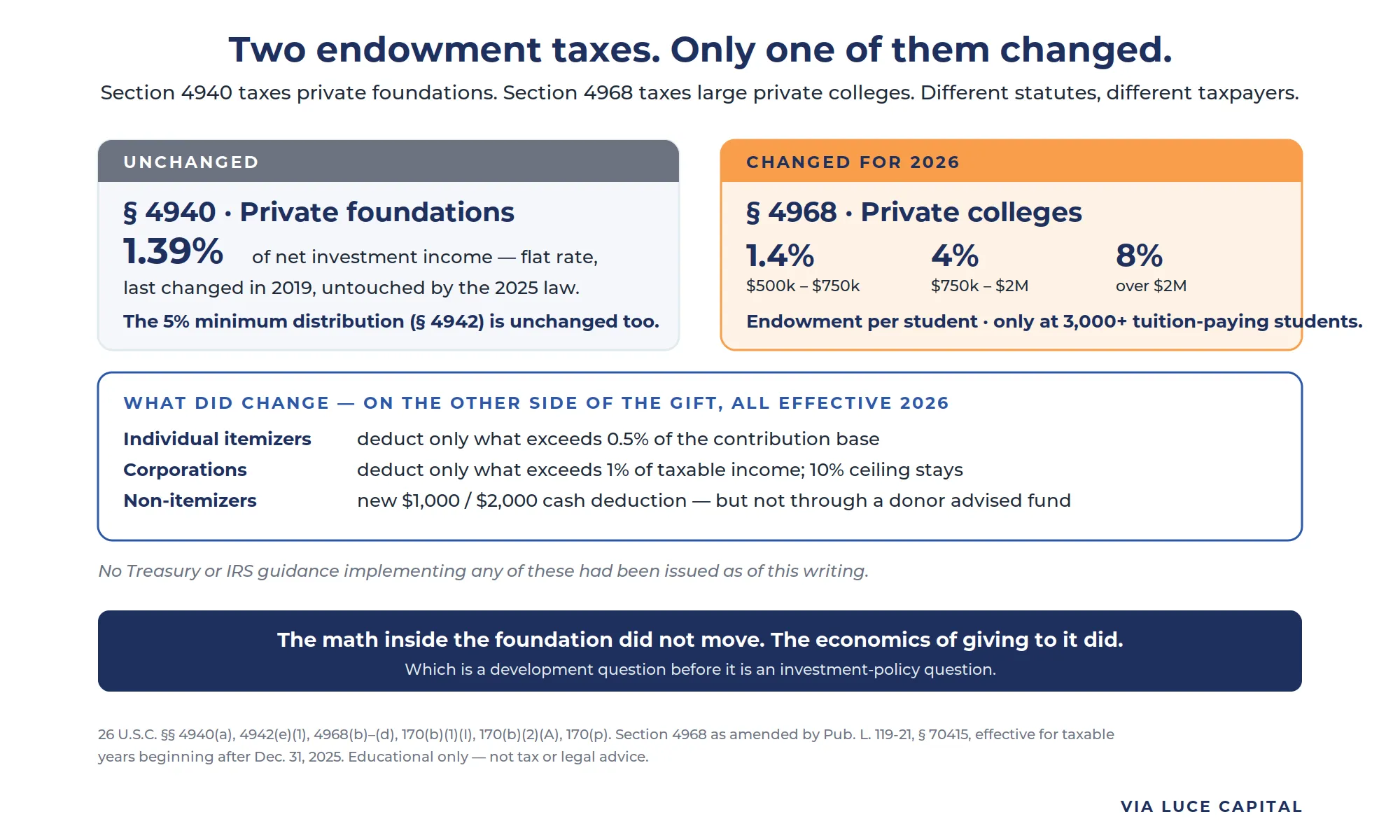
Section 4940 imposes an excise tax on the net investment income of a private foundation. It is a flat 1.39 percent. That rate has been in place since 2019, when it replaced an older two-tier structure, and the 2025 law did not amend the section at all.
Section 4968 imposes an excise tax on the net investment income of applicable educational institutions — private colleges and universities. For taxable years beginning after December 31, 2025, it is tiered: 1.4 percent, 4 percent, or 8 percent, depending on endowment per student. And it now reaches only institutions with at least 3,000 tuition-paying students, raised from 500.
These sit in different subchapters and apply to different organizations. A foundation board reading about a graduated endowment tax is reading about a statute that does not apply to it.
What did not change
The foundation-side arithmetic is where a board’s attention usually goes first, so it is worth being direct about it.
The 1.39 percent on net investment income is unchanged. The 5 percent minimum investment return that drives the distributable amount is also unchanged — that section has not been amended since 2014.
Which means the two inputs a board would normally revisit in response to a tax change are both exactly where they were. A spending policy built around a 5 percent payout and a 1.39 percent excise drag does not need rewriting because of this law.
What did change is on the other side of the gift
The 2025 law reshaped the economics of giving rather than the economics of holding. Three changes, all effective for 2026.
Individual itemizers may deduct charitable contributions only to the extent they exceed 0.5 percent of the contribution base — adjusted gross income, computed without regard to a net operating loss carryback. Below that line, a gift produces no deduction.
Corporations may deduct only what exceeds 1 percent of taxable income, and the existing 10 percent ceiling stays. The five-year carryforward is retained. A corporate donor now has a floor and a ceiling.
Taxpayers who do not itemize get something new: a deduction of up to $1,000, or $2,000 on a joint return, for cash contributions. It is permanent and it is not inflation-indexed.
That last one carries an exclusion worth reading closely. It does not apply to contributions to a supporting organization, and it does not apply to contributions made to establish or maintain a donor advised fund.
Which of those matters depends on who funds you
This is where the question becomes specific rather than general, and it is a development question before it is an investment question.
An organization funded largely by a handful of major individual donors is looking at the 0.5 percent floor, which for a large gift is a rounding error and for a modest one may be the whole deduction.
An organization with meaningful corporate support is looking at a new floor that did not exist before, and at donors who may now bunch corporate giving into alternating years to clear it.
An organization with a long tail of small gifts is looking at a genuinely new incentive for donors who take the standard deduction — but only for cash given directly. If those gifts arrive through a donor advised fund, the new deduction does not reach them.
What a board can usefully do
- Do not rewrite the spending policy for a tax that did not change. The 1.39 percent and the 5 percent are both where they were.
- Ask the development side for the donor mix — individual itemizers, corporate, and small-dollar non-itemizers as a share of giving. The three changes land on those three groups differently, and no board can tell which matters without that breakdown.
- Note that no guidance has been issued. No notice or revenue procedure implementing these provisions had been published as of this writing, and at least one open question — how amounts disallowed by the individual floor are treated going forward — has no primary answer yet. Anything a board decides now should be revisited when guidance appears.
- Keep the organization’s counsel and accountants in it. These are statutory changes with mechanical effects, and the mechanics are where the surprises live.
The pattern
A tax change arrives, and the instinct is to ask what it does to the balance sheet. Sometimes the honest answer is nothing — and the change is happening one step upstream, to the people who fund the balance sheet.
The question is not what the new law does to the endowment. It is what it does to the next gift.
Governance is partly the discipline of confirming which questions actually apply before answering them. The plan is the residue. The planning is the work.
Sources
- The private foundation excise tax on net investment income is a flat 1.39 percent — 26 U.S.C. § 4940(a)
- The minimum investment return used to determine a private foundation's distributable amount is 5 percent of the excess of non-charitable-use assets over acquisition indebtedness — 26 U.S.C. § 4942(e)(1)
- Tiered excise tax on the net investment income of applicable educational institutions — 1.4 percent, 4 percent and 8 percent by student adjusted endowment — and the requirement of at least 3,000 tuition-paying students, applicable to taxable years beginning after December 31, 2025 — 26 U.S.C. § 4968(b)–(d), as amended by Pub. L. 119-21, § 70415
- Individual charitable contributions are deductible only to the extent they exceed 0.5 percent of the taxpayer's contribution base, which is adjusted gross income computed without regard to any net operating loss carryback — 26 U.S.C. § 170(b)(1)(H), (b)(1)(I), as added by Pub. L. 119-21, § 70425
- Corporate charitable contributions are deductible only to the extent they exceed 1 percent of taxable income and do not exceed 10 percent of taxable income, with the five-year carryforward retained — 26 U.S.C. § 170(b)(2)(A), (d)(2)(A), as amended by Pub. L. 119-21, § 70426
- A deduction of up to $1,000 ($2,000 on a joint return) for cash contributions by taxpayers who do not itemize, excluding contributions to supporting organizations and contributions to establish or maintain a donor advised fund — 26 U.S.C. § 170(p), as added by Pub. L. 119-21, § 70424
- The individual charitable floor and the non-itemizer deduction take effect beginning in 2026 — Internal Revenue Service, Publication 505 (2026), What's New for 2026