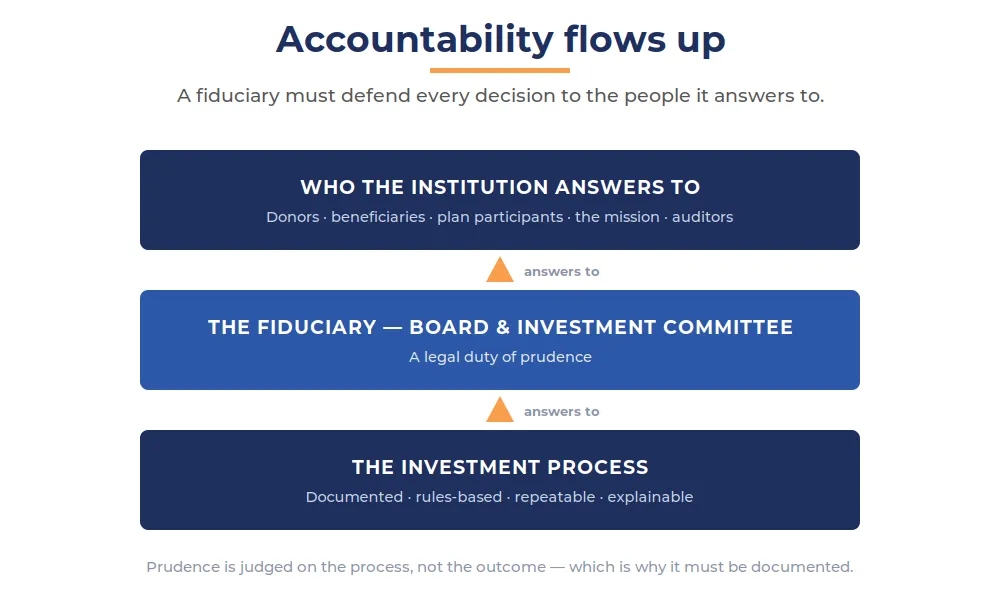
When you manage money for an institution, you answer to a board, an auditor, and a mission. “It felt like the right call” is not an answer any of them can accept.
A foundation, an endowment, a nonprofit’s reserve, a company’s retirement plan — every one of them is run by fiduciaries: people legally bound to manage someone else’s money with care, and to be able to prove they did. That single fact should reshape what an institution looks for in an investment partner. The question isn’t “who can beat the market?” It’s “whose decisions can we stand behind?”
Prudence is judged on process, not outcome
The laws that govern institutional money — ERISA for retirement plans, the Uniform Prudent Management of Institutional Funds Act for nonprofits and endowments, the prudent-investor standard for trusts — share a backbone. A fiduciary is judged on the prudence of the process they followed, not on whether a given year finished up or down. A good result from a reckless process is still a breach; a poor year from a sound, documented process is defensible. That inverts how most people think about investing. For an institution, the process is the product.
The problem with prediction
Most active management is, underneath, a series of predictions — this sector, this manager, this moment to move. Set aside whether prediction works and ask a different question: can your committee defend it to the board? “We thought rates would fall” isn’t a process; it’s a bet, and bets are nearly impossible to govern. When a call is wrong — and some always are — there’s no rule to point back to, only judgment that didn’t pan out. That’s precisely the position a fiduciary can’t afford to occupy.
What a fiduciary should actually demand
A documented, repeatable process. Decisions driven by defined rules rather than discretion or gut, so every position can be explained and every change has a reason on record.
Alignment to the mandate. A strategy fitted to the institution’s real job — an endowment’s spending rate, a foundation’s grant liquidity, a plan’s obligations to participants — not forced into a single house model.
Transparency you can take to a board. Reporting in plain language that a committee member, an auditor, and a donor can all follow.
Consistency across cycles. A process built with a goal to behave the same way in calm and in stress, so governance doesn’t hinge on one person’s nerve in a bad quarter.
True fiduciary alignment. A manager held to the same standard of care the institution itself owes.
Why rules-based fits the fiduciary mandate
This is where a rules-based, evidence-based approach stops being a matter of taste and becomes a governance asset. A process built on defined, repeatable rules is, by its nature, documentable and explainable — the two things a fiduciary needs most. The investment policy statement sets the mandate; the process executes it the same way every time; every decision traces back to a rule rather than a hunch. That’s not only easier to defend. It’s easier to audit, and easier to stay disciplined through exactly the stretches when discipline is hardest to hold.
It also has to fit the institution in front of it. The firm’s frameworks are built with a goal to be configured to the mandate — implemented at the risk level and equity exposure a given policy calls for — rather than pushing every client through one setting.
What this means for your committee
If you sit on an investment committee, the test is simple: could you walk your board through every major decision and show the rule behind it? If the honest answer is “not really — we trust the manager’s judgment,” that’s a governance gap, not a strategy. Institutional-quality investing was never about access to something exotic. It’s about a process disciplined and transparent enough that meeting your fiduciary duty becomes the default rather than extra work.
Where this leaves you
Returns matter. But for an institution, returns earned through a process you can’t explain are a liability waiting to surface. The managers worth hiring are the ones who can hand your committee not just performance, but the documented reasoning behind every step — because when the board asks “why,” “here’s the rule” is an answer, and “it felt right” never is.
A good outcome from a reckless process is still a breach. For a fiduciary, how you decide is the decision.
Performance gets the attention. Process is what survives the audit.