
The Department of Labor has proposed a safe harbor for choosing what goes on a 401(k) investment menu. Most of the commentary has read it as a door opening for private assets. Read as written, it is a description of a process — and the more interesting question is whether a committee could pass it on the funds already sitting on the menu.
If you sponsor a retirement plan, a version of this pitch is coming, if it has not arrived already. Private credit, private equity, an evergreen structure inside a target date sleeve, presented with the observation that the Department of Labor has proposed a rule that makes it defensible.
The first half of that is true. The second half is worth reading more carefully than most summaries of it.
What the proposal actually says
Published in the Federal Register in March 2026, with the comment period since closed, it remains a proposal. It has not been finalized. It may change materially, and it may never be adopted at all. Nothing a committee does today should assume otherwise.
What it sets out is a process. A fiduciary who objectively, thoroughly, and analytically considers the enumerated factors, and makes a determination about them, is presumed to have acted reasonably.
Read that carefully. It is a presumption about the reasonableness of a judgment. It is not immunity from suit, and it is not immunity from liability. The safe harbor is also optional, and the proposal is explicit that declining to use it is not by itself imprudent.
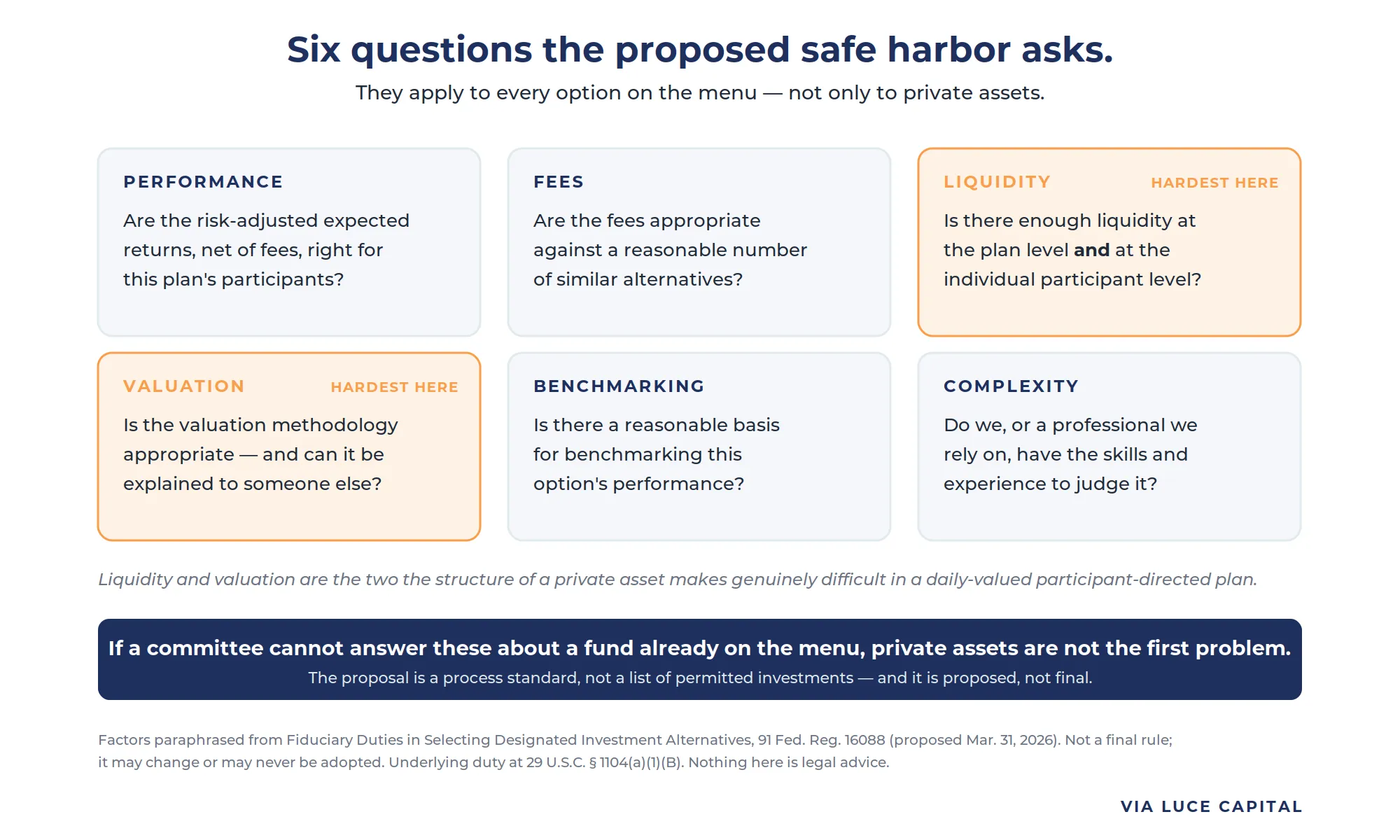
The six factors are performance, fees, liquidity, valuation, performance benchmarking, and complexity — the last meaning whether the fiduciary, or a professional the fiduciary relies on, has the skills and experience to evaluate the thing at all.
The part most summaries skip
The proposal applies to designated investment alternatives generally. Not to alternatives. Not to private assets. To every option on the menu.
That reframes the whole exercise. These are not six questions about private credit. They are six questions about the target date series, the stable value option, the international fund nobody has looked at since it was added, and everything else a participant can choose.
Which suggests a more useful first move than evaluating a new asset class.
Two of the six are structurally harder here
Four of the factors are ordinary diligence. Two are different in kind when the asset is private.
Liquidity has to work at two levels. Not only whether the plan can meet its obligations, but whether an individual participant can take a distribution, change an election, or roll out on the timeline they are entitled to. A structure that is liquid at the plan level and illiquid at the participant level has moved a problem rather than solved it.
Valuation has to be appropriate, which in a participant-directed plan really means it has to be daily, defensible, and explainable. Private assets are marked on a schedule and a methodology, not a screen. That is not disqualifying, and the proposal does not treat it as such. It does mean somebody has to be able to explain how the number gets made — to a participant, to an auditor, and potentially to a court.
Benchmarking is where the pressure is
Benchmarking is one of the six factors. It is also the subject of a case now pending before the Supreme Court, on whether a claim that a fiduciary was imprudent because a fund underperformed has to plead a meaningful benchmark.
That case is fully briefed and undecided. Nothing about how it comes out should be assumed, and this post is not going to guess.
The observation worth making is narrower and safer: two independent lines of pressure — a proposed regulation and a pending case — have converged on the same question, which is whether a plan can articulate what a given option is supposed to be measured against. For an asset with no daily price and no obvious index, that question is harder to answer, and it is being asked from two directions at once.
What changed, and what did not
The Department’s 2020 information letter, which concluded that offering a professionally managed asset allocation fund with a private equity component would not violate ERISA solely by virtue of that component, remains in effect.
A 2021 supplemental statement that cautioned smaller plan fiduciaries against those structures was rescinded in August 2025 — seven months before this proposal appeared. The proposal did not undo it; that had already happened.
What did not change is the underlying duty. Care, skill, prudence, and diligence under the circumstances then prevailing, exercised as a person familiar with such matters would. That standard neither requires nor forbids any particular investment, and it was the operative test before any of this and remains the operative test now.
What a committee can usefully do now
Nothing that depends on the rule being adopted. But the six questions are available immediately, and they cost nothing to ask:
- Run them against the menu you already have. Take the six factors, take each existing option, and see which questions the committee can answer from its own minutes and files.
- Note the ones you cannot answer. Those are governance gaps that exist today, independent of what happens to the proposal.
- Write down the answers you can give. A determination that was made but never recorded is difficult to distinguish, later, from one that was never made.
- Separate the asset question from the process question. Whether private assets belong in a particular plan depends on that plan. Whether the committee has a process capable of answering the question does not.
The pattern
The instinct when a rule appears is to ask what it now permits. The more useful question is what it assumes you were already doing.
A determination you can only describe after somebody asks about it is difficult to distinguish from one that was never made.
Governance is not a document produced when a decision is challenged. It is the record of decisions made in the ordinary course, on the evidence available, and written down at the time. The plan is the residue. The planning is the work.
Sources
- The proposed rule, its six enumerated factors, the standard that a fiduciary who objectively, thoroughly and analytically considers them is presumed to have acted reasonably, and the statement that the safe harbor is non-exclusive and applies to designated investment alternatives generally — Fiduciary Duties in Selecting Designated Investment Alternatives, 91 Fed. Reg. 16088 (proposed Mar. 31, 2026) (RIN 1210-AC38); comment period closed June 2026; not a final rule
- The statutory duty of prudence a plan fiduciary owes — care, skill, prudence and diligence under the circumstances then prevailing — 29 U.S.C. § 1104(a)(1)(B) (ERISA § 404(a)(1)(B))
- The executive order directing the Secretary of Labor to propose rules clarifying fiduciary duties, which may include appropriately calibrated safe harbors — Exec. Order No. 14330, Democratizing Access to Alternative Assets for 401(k) Investors, 90 Fed. Reg. 38921 (Aug. 12, 2025)
- The qualified default investment alternative regulation, which the proposal does not amend — 29 C.F.R. § 2550.404c-5
- Department of Labor guidance that a fiduciary would not violate ERISA solely by offering a professionally managed asset allocation fund with a private equity component as a designated investment alternative — U.S. Department of Labor, Employee Benefits Security Administration, Information Letter to Jon W. Breyfogle (June 3, 2020)
- Rescission of the December 2021 supplemental statement on private equity in defined contribution plan designated investment alternatives — U.S. Department of Labor News Release, US Department of Labor rescinds 2021 supplemental statement on alternative assets in 401(k) plans (Aug. 12, 2025)
- Pending Supreme Court case on whether a claim that a plan fiduciary breached the duty of prudence for fund underperformance requires pleading a meaningful benchmark — Anderson v. Intel Corp. Investment Policy Committee, No. 25-498 (U.S., cert. granted Jan. 16, 2026) (argument pending; undecided)