

Choosing a financial adviser starts with the decisions your household needs to make. Put those decisions on paper, then ask each professional to explain the work, the cost, and who is responsible for doing it.
A search for a financial adviser in Orange County produces plenty of names. A family preparing for retirement in Costa Mesa may need help replacing a paycheck. An executive in Irvine may be deciding what to do with company shares. A business owner in Newport Beach may be trying to connect a possible sale with life afterward.
Those are different assignments. The useful question is whether a proposed relationship covers your assignment clearly enough that you understand what you are buying.
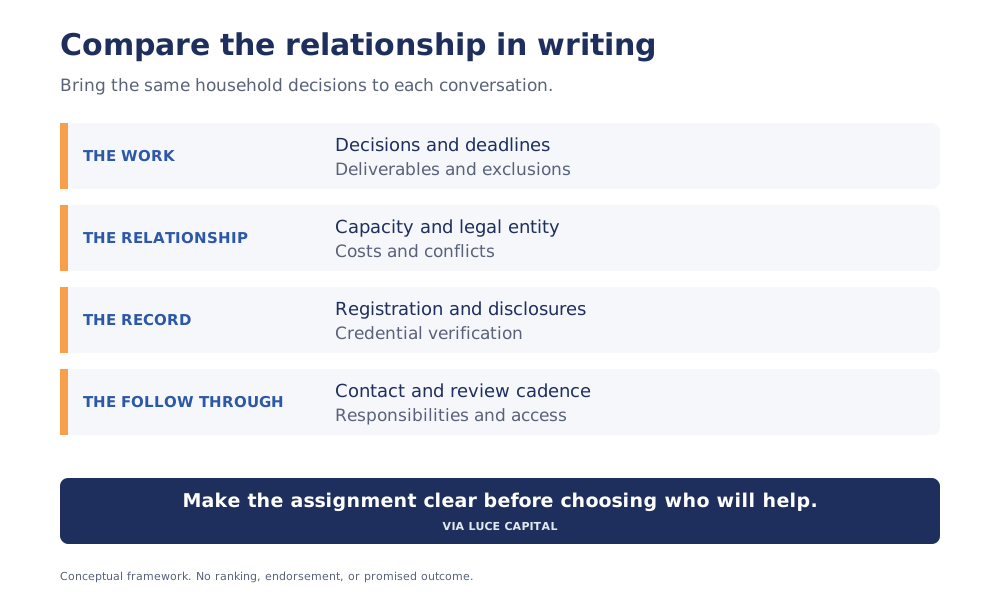
Start with a short list of decisions, dates, and concerns. Bring the same list to each introductory meeting. It gives you a practical basis for comparing answers, without treating a polished presentation as evidence of a particular result.
Define the work before comparing the names
Write down the next decisions your household faces. For example: a retirement date, the sale of a property, support for a parent, or how to handle an inheritance. Note what has already been decided and what remains open. An adviser cannot meaningfully explain a proposed engagement if the conversation never gets beyond your account balance.
Then ask what the engagement actually includes. Does it cover a written financial plan, an investment strategy, recurring review meetings, or coordination with your CPA and attorney? Which services require a separate agreement or fee? Who handles the work between meetings?
Ask for a concrete description of the first several months. What information will you provide? What analysis will you receive? Which decisions will be discussed first? The answer should connect the service to your circumstances without promising a financial outcome.
Also name the limits. Your attorney remains responsible for legal advice and documents. Your tax professional handles tax advice and return preparation within that engagement. Financial coordination is useful when everyone knows where responsibility begins and ends.
Understand the relationship and the capacity
The terms adviser, broker, planner, and insurance professional describe different roles and sometimes overlap. A person may work in more than one capacity. Ask which role applies to the service or account under discussion, which firm provides it, and where that is documented.
Form CRS, the customer or client relationship summary, is a useful starting point. It describes services, costs, conflicts, standards of conduct, and reportable disciplinary history. Read it alongside the proposed agreement and applicable disclosures. The SEC provides an explanation and search tools at Investor.gov. 1
If you ask about fiduciary requirements, be specific about the advisory relationship and the work covered. Ask how conflicts are disclosed and addressed. Avoid assuming that a title describes every activity a professional performs. The relevant responsibilities depend on the relationship and service, and the written explanation should match what you heard in the meeting. 1
Keep the legal entity names on your comparison sheet. They may differ from the name on an office door. That matters when locating registration records, disclosures, and the agreement you would sign.
Compare the full cost with the full scope
A quoted fee is easier to assess when you know the calculation. Ask whether charges are based on assets, a flat amount, hours, transactions, insurance compensation, or a combination. Ask which costs are paid directly and which are reflected within an investment or contract. 2
Have the professional describe the anticipated charges using the accounts and services you are actually considering. Ask about separate planning charges, underlying investment expenses, account fees, transfer or termination charges, and circumstances in which the cost changes. Not every item applies to every arrangement. 2
Then compare equivalent scopes. A limited engagement for a defined question and an ongoing advisory relationship may provide different work. A lower headline price does not explain those differences; a higher price does not establish better results. The comparison should show the deliverables, review frequency, responsibilities, and total anticipated costs together.
Ask how the professional and firm are paid if you follow a recommendation. If the explanation is hard to follow, request a written breakdown. You should be able to explain the arrangement to another member of your household before deciding.
Check the records and the credentials
Use FINRA’s BrokerCheck and the SEC’s Investment Adviser Public Disclosure resources to check the individual and the firm. Review the actual reports, including registration and disclosure sections, rather than stopping at a name match. A reported event deserves context and follow-up; its presence alone does not tell the whole story. 3
Credentials deserve their own check. Find out which organization grants a designation, what the requirements are, and how to confirm current status. FINRA’s professional-designation resource explains that it does not approve or endorse credentials. Registration and a professional designation answer different questions. Neither predicts an investment outcome. 4
Make sure the record belongs to the right person. Similar names and different firm names can cause confusion. Ask the professional to identify the relevant registrations and provide the disclosure documents for the proposed relationship.
Save what you reviewed and when. If your decision is several months away or the proposed relationship changes, revisit the records and documents before signing.
Test how the relationship would work
Bring a realistic question to the meeting. A hypothetical household might be weighing retirement next year against helping an adult child buy a home. This is an illustrative situation, not a real client or a recommendation. Ask how the professional would organize the information and identify the tradeoffs before proposing action.
Listen for the questions asked in return. Spending commitments, account types, timing, health coverage, and both spouses’ preferences may change the analysis. A useful discussion makes assumptions visible. It also identifies which answers require a CPA, attorney, or another specialist.
Discuss communication in ordinary terms. Who will attend review meetings? How are action items recorded? Who responds when a decision cannot wait until the next scheduled meeting? What happens if the primary contact is unavailable? Ask how access and responsibility would work for a spouse or authorized family member.
Local availability may matter to you. So may remote meetings, secure document exchange, or experience with the type of decision you face. State your preferences plainly. Convenience is part of fit, but it should be considered alongside scope, cost, and the working relationship.
Before moving forward, read the agreement at your own pace. Confirm cancellation terms, account authority, and any remaining questions. Record what is included and what would require separate approval or a different engagement.
The pattern
Choosing an adviser is a decision about an ongoing working relationship. The strongest comparison starts with the same household questions and ends with written answers you can understand. A persuasive conversation is only the beginning of that review.
Bring your decision list, the proposed service agreement, the relevant disclosures, and your remaining questions together. If you are considering a conversation with Via Luce Capital, use that same process. Securities and advisory services are offered through LPL Financial; the firm relationship is explained in the disclosures below.
Choose the relationship by the work you need and the responsibilities you can see.
The plan is the residue. The planning is the work.
Sources
- Services, fees, conflicts, capacity and conduct standards. — [1] SEC Investor.gov, Form CRS; reviewed September 26, 2026.
- Professional relationships, services and compensation. — [2] FINRA, Working With an Investment Professional; reviewed September 26, 2026.
- Registration and disclosure records; check the individual and firm. — [3] SEC Investor.gov, Ask and Check; reviewed September 26, 2026.
- Credential requirements vary; FINRA does not endorse designations. — [4] FINRA, Professional Designations; reviewed September 26, 2026.