The risk you didn’t choose
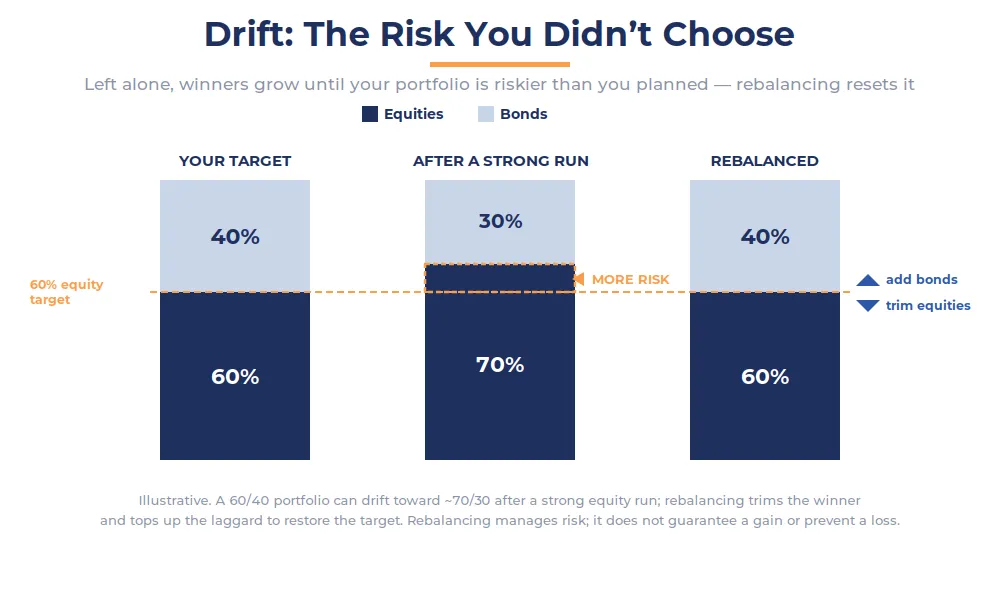
A portfolio built at 60% stocks and 40% bonds doesn’t stay there. When stocks have a strong run, the equity slice swells — and a few good years can quietly carry you from 60/40 to 70/30 without a single decision on your part. You now own a materially more aggressive portfolio than the one you signed off on.
The trouble is that drift is silent. Nothing flashes red when your risk creeps up; the statement just shows a bigger number, which feels good. Then the next downturn arrives and hits a portfolio that’s more exposed than you intended — and the loss is larger than the plan was built with a goal to tolerate. The risk you never chose is the one that hurts most, because you weren’t braced for it.
Why rebalancing is hard to do by feel
Rebalancing is the fix, and on paper it’s simple: sell a little of what’s grown past its target and buy more of what’s fallen behind, returning the mix to plan.
In practice it runs straight into human nature. Rebalancing asks you to trim your best-performing asset right after it’s done well, and to add to your worst-performing one right after it’s disappointed. Every instinct resists. After a banner year for stocks, selling some feels like quitting a winning streak; buying more of the laggard feels like throwing good money after bad. So the investor who plans to “rebalance when it feels right” almost never does — because the moment it would help most is the exact moment it feels worst.
A rule removes the argument
This is where a rule earns its keep. There are two common disciplines, and both work. A calendar approach checks the portfolio on a set schedule — say once a year — and resets anything that’s drifted. A threshold approach rebalances whenever an allocation moves past a defined tolerance band, for instance five percentage points away from its target, regardless of the date.
What they share is the important part: the decision gets made in advance, in a calm moment, and then simply executed when the trigger hits. There’s no debate in the heat of a rally or a selloff, because the rule already settled it. The investor doesn’t have to overrule their own emotions in real time — the system does it for them. That’s the whole point. A rule’s value isn’t that it’s clever; it’s that it’s consistent.
What rebalancing is — and isn’t — for
It’s worth being precise about the goal, because rebalancing is often oversold. It is a risk-control discipline, not a return maximizer. Its job is to keep your portfolio aligned with the level of risk your plan calls for — not to time the market or to beat it.
Some years, a rebalance will look like it cost you: you trimmed a winner that went on to climb further. Other years it spares you real pain. The value isn’t in any single year’s scoreboard — it’s in never drifting, unnoticed, into a risk posture your plan didn’t intend right before it matters. Consistency, not prediction, is what it buys.
Doing it tax-aware
In a taxable account, selling to rebalance can trigger capital gains, so the discipline has to be applied with an eye on taxes — otherwise you can hand back part of the benefit. Several levers help: rebalancing inside tax-advantaged accounts, where trades don’t create a tax bill; steering new contributions and dividends toward the underweight asset so the portfolio self-corrects without selling; harvesting losses to offset gains realized in the process; and using tolerance bands so you trade only when drift is genuinely meaningful rather than constantly. Done well, you stay on target without the tax cost quietly eroding the point.
Where this fits our approach
Rebalancing is a small window into a larger conviction: that disciplined, rules-based decisions tend to serve investors better than improvised ones. Portfolios here are built and managed within defined parameters, with rebalancing handled as a systematic, tax-aware process rather than a judgment call made under pressure. The aim isn’t to be clever in any given moment — it’s to behave consistently across all of them, whether the headlines are euphoric or grim.
A rule’s whole value is that it behaves the same whether the market is euphoric or terrified. You don’t.
The investor who rebalances on a rule isn’t smarter than the one who improvises — just more consistent. And over a long horizon, consistency is the part that compounds.